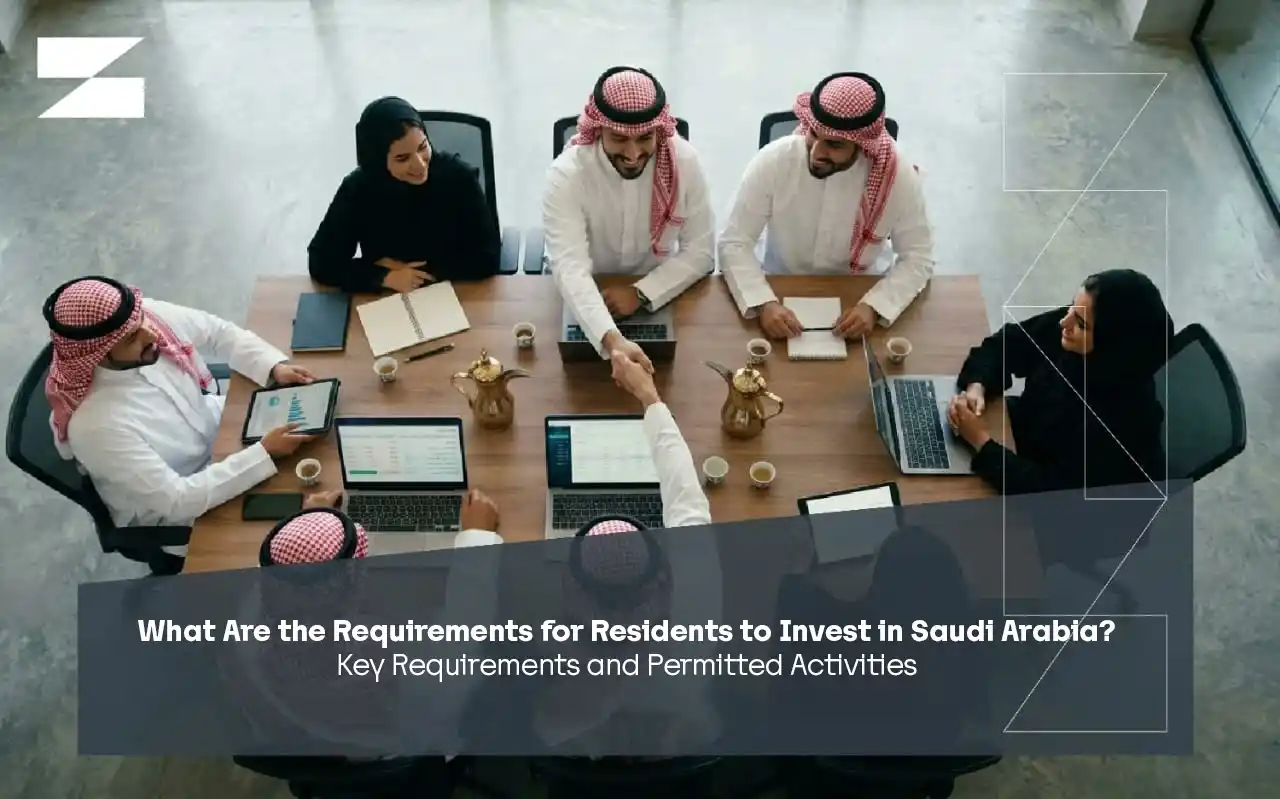
Saudi Arabia is undergoing a major transformation in investment, and the door is now open to residents who want to build a financial future and invest. If you are an expatriate resident of the Kingdom looking to turn your capital into a real business, you have probably asked yourself the most important question: what are the requirements for residents to invest in Saudi Arabia? Understanding these requirements is essential before taking any step.
Whether a resident can invest depends on several factors, including the type of residency, the nature of the commercial or professional activity and the regulatory requirements of each sector.
Requirements and procedures also differ depending on whether you invest as an individual or through a company, and some activities require additional approvals or licenses from the competent authorities.
Article Contents
ToggleResidency Requirements for Investing in Saudi Arabia
Legal residency is a basic requirement for carrying on investment activities in Saudi Arabia, but the type of residency plays an important role in determining whether a resident is entitled to set up a project, own a company or carry on an investment activity lawfully. It is therefore essential to know which types of residency allow investment, and the rules attached to them, before starting any project. You can do so through foreign investor residency or business investor residency.
Legal procedures differ depending on the type of residency and the nature of the activity. Contact ASAS for legal advice to help you find the best option for your situation.
Does a Work Residency Allow You to Set Up a Company in Saudi Arabia?
A work residency gives its holder the right to work for a specific employer (the sponsor), so it does not entitle the holder to set up a company or carry on a business independently. To do so lawfully, the holder must obtain an investment license from the Ministry of Investment (MISA) and change their profession in line with the requirements.
What Are the Requirements for an Investor Residency?
Obtaining an investor residency involves meeting a set of conditions so you can carry on business lawfully, including obtaining an investment license, determining the capital, and having a commercial registration and financial records. The articles of association must also be provided, and a general manager residing in the Kingdom must be appointed.
Can a Companion or Dependent Invest?
Companion or dependent status does not give the right to carry on investment or commercial activities. The person may need to change their legal status from companion or dependent to investor to obtain a legal status that allows the activity to be carried on in accordance with the applicable laws.
Can You Invest on a Visit or Tourist Visa?
Saudi Arabia offers a business visit visa that gives investors a multiple-entry e-visa valid for up to a full year to explore available investment opportunities, and you can apply for it easily through the Ministry of Investment.
What Are the Steps for Residents to Invest in Saudi Arabia?
Investing and setting up a company as a resident in Saudi Arabia requires following a set of legal procedures that ensure the business is established lawfully and starts operating in accordance with the applicable laws. Following these steps makes the formation process easier and avoids delays or procedural obstacles in the early stages of the project.
- Check the type and validity of your residency
The first step is to make sure your type of residency allows you to carry on an investment activity or set up a company, to check that your residency is valid, and to meet any legal requirements related to your status as an investor.
- Choose the right activity
Identify the commercial or professional activity you want to carry on and make sure it is among the activities permitted for resident investors, studying the requirements and licenses specific to each activity.
- Issue the commercial registration
After choosing the activity and the appropriate legal entity, complete the procedures for issuing the commercial registration, which is the key document for doing business officially in the Kingdom.
- Obtain the required licenses
Some activities or sectors may need additional licenses or approvals from specialized regulators, so make sure all necessary permits are in place before the project actually starts operating.
- Open a bank account and complete the operating procedures
The final stage involves opening a bank account in the business’s name, registering on the relevant government platforms and completing the operational and administrative requirements needed to start the activity and do business lawfully.
Setting up a project in Saudi Arabia requires precise legal steps. The ASAS team supports you with formation procedures, licensing and preparing the required documents.
What Are the Requirements for Residents to Invest in Saudi Arabia?
Investing in Saudi Arabia as a resident requires meeting a set of conditions designed to regulate economic activities and ensure they comply with the laws in force in the Kingdom. These conditions start with an investment license issued by the Ministry of Investment after a clear feasibility study for the project is submitted, followed by establishing financial solvency, which varies from one activity to another. The procedures for issuing a commercial registration for residents then begin, making sure the activity is not among those excluded for residents.
The requirements for residents also include choosing a legal entity suited to the activity and complying with the relevant tax, zakat and regulatory rules. Some requirements may vary with the nature of the activity, the investor’s nationality or the type of residency they hold. It is therefore advisable to study the requirements of each activity before starting the formation procedures, so you can invest lawfully and benefit from the opportunities in the Saudi market without regulatory or legal obstacles.
Before you invest, make sure your project complies with Saudi law. ASAS advisors can help you review the legal requirements and avoid future obstacles.
The Best Investment Areas for Residents in Saudi Arabia
Some may wonder what the best investment is for residents in Saudi Arabia. The Kingdom offers many promising investment opportunities for residents, especially in fast-growing sectors supported by digital transformation and infrastructure development. Choosing the right area depends on the investor’s experience, available capital and the needs of the target market.
1. Technology Investment
Technology is one of the most attractive sectors for investment, with growing demand for app and digital platform development, technology solutions, artificial intelligence and cybersecurity services, and financial technology (FinTech), in line with the Kingdom’s digital transformation.
2. Restaurants and Cafés
The restaurant and café sector continues to grow strongly thanks to population growth, expanding cities and rising demand for diverse food experiences, making it a favorite with many investors.
Residents can invest easily in this sector as long as they obtain the necessary licenses, including the municipal license.
3. Logistics
Saudi Arabia aims to strengthen its position as a global logistics hub, which opens up major opportunities to invest in transport, warehousing, distribution and supply chains, especially as domestic and international trade expands.
4. E-Commerce
E-commerce is growing steadily as more people shop online and payment systems and logistics services develop, making it one of the most promising areas for residents who want to start flexible, scalable businesses.
Which Investment Activities Are Permitted for Residents in Saudi Arabia?
Saudi Arabia opens most activities and fields to investment by residents, in accordance with the laws and rules set by the Kingdom. You can start investing once you have made sure all the set conditions are met and the necessary licenses obtained. The activities permitted for residents include investment in the financial sector, e-commerce, logistics, industrial and commercial activities, tourism and entertainment, services and business, real estate development, contracting, advertising, engineering, energy and mining projects, and catering and food services.
It is therefore always advisable to check the permitted activities and the regulatory requirements attached to them before starting the investment procedures, to ensure full compliance and a stable, successful start.
Choosing the right activity directly affects the licensing process and the success of the project. Get advice from ASAS on the activities that suit your legal status.
Which Investment Activities Are Prohibited for Residents in Saudi Arabia?
Although the Kingdom keeps expanding and offering resident investors opportunities to invest in many fields, some investment areas remain prohibited for them. These include petroleum exploration, which falls under industry; all insurance and catering services for the military sector; investigations and security; fishing of aquatic resources; Hajj-related tourism guidance; and real estate investment in Makkah and Madinah.
How Much Capital Do Residents Need to Invest in Saudi Arabia?
Capital is one of the main concerns for residents who want to invest in Saudi Arabia, but there is no single amount for all activities: it varies with the nature of the project, the target sector and the requirements of each activity. It is therefore important to understand the financial requirements before starting the formation procedures.
What Is the Minimum Investment for Residents in Saudi Arabia?
Capital varies by type of activity, but it is not less than SAR 500,000 in the commercial and service sectors, while it can reach SAR 5 million for the industrial sector. Capital in the agricultural sector must be at least SAR 25 million. It is therefore important to understand the financial requirements before starting the formation procedures.
Proof of Financial Solvency
Financial solvency reflects the investor’s ability to run and sustain the project, and it is one of the basic requirements for residents to invest or obtain Premium Residency in the Kingdom. Financial solvency is proven by submitting bank statements or the company’s financial statements, as well as documents proving ownership of fixed assets such as real estate or bonds.
Can the Company Be Financed by a Saudi Bank?
And can a resident obtain bank financing to set up their company? These are questions on the mind of every resident investor. Eligible businesses can benefit from certain bank financing programs or financing provided by business-support entities, subject to each financing provider’s conditions and whether the project meets the credit requirements.
How Does Financing Differ for Residents and Citizens?
There are three main criteria that distinguish financing for residents from financing for citizens. The first is length of residency: financing is readily available to citizens and retirees, whereas a resident must have a valid residency and be in active employment. Another key difference is the financing amount: the Kingdom gives citizens a higher financing ceiling and longer repayment periods of up to 60 months, while for residents the amount and repayment period are lower and usually tied to the expiry date of the residency or employment contract.
How Much Does an Investor Residency Cost in Saudi Arabia?
The cost of an investor residency in Saudi Arabia varies with the type of residency and the program through which the investor applies. If you obtain a residency linked to an investment activity and the formation of a company, it is considered a Premium Residency, and the cost starts from SAR 4,000 paid once a year as an application fee.
The financial requirements for the Business Investor category include proof of investments of at least SAR 7 million, while the Entrepreneur category requires an investment round of at least SAR 400,000.
There is also the foreign investment license residency, which costs between SAR 2,000 and SAR 5,000 and also varies with the type of activity.
Taxes and Zakat on Residents’ Investments in Saudi Arabia
Taxes and zakat are among the basic financial obligations a resident investor in Saudi Arabia must understand before starting a business, as they directly affect the business’s operating costs and legal obligations. These obligations vary with the company’s structure, the owners’ nationality, the nature of the activity and the size of revenue.
1. Corporate Tax for Resident Investors
Some businesses owned by non-Saudi investors may be subject to income tax under the tax laws in force in the Kingdom. The tax is charged at 20% and is calculated on the tax base in the case of mixed ownership, while otherwise it is calculated on the net income or profits generated.
2. Zakat and Financial Obligations
Whether zakat or tax applies depends on the ownership structure and the proportion of Saudi and non-Saudi partners in the company. If the investor is Saudi or a GCC national, zakat applies at 2.5%, while a foreign investor is subject to income tax at 20% of net profits.
3. Value Added Tax
VAT is charged at 15% on taxable goods and services. Investors must register for VAT once their revenue exceeds SAR 375,000, while registration is voluntary if revenue reaches SAR 187,500.
4. Withholding Tax and Statutory Obligations
Some commercial transactions and payments made outside Saudi Arabia may give rise to additional obligations, such as withholding tax or disclosure and financial reporting requirements, which means you must comply with accounting and tax rules to avoid violations and fines and keep the business running lawfully. Statutory obligations include registering the investor with the Zakat, Tax and Customs Authority and keeping accounting records and supporting documents.
Can a Resident Invest in Saudi Arabia Without a Saudi Partner?
One of the most common questions among residents who want to set up projects in Saudi Arabia is whether they need a Saudi partner. The answer depends mainly on the type of investment activity and the legal structure of the project: modern regulations have opened many opportunities for full ownership in certain sectors and for investing without a Saudi partner, while certain activities remain subject to special requirements.
Activities That Allow Full Ownership
Many service, technology, consulting and investment activities allow a qualified investor to own 100% of the project after meeting the legal requirements and obtaining the necessary licenses. Economic reforms have expanded the range of activities open to full ownership to attract investment and support private-sector growth.
Want to know whether you can fully own your project? ASAS provides legal advice on investment options and the most suitable legal structure.
Which Activities Require a Saudi Partner?
Some activities are still subject to special rules or regulatory requirements that may require a Saudi partner or additional requirements related to the nature of the activity and its economic or regulatory importance, in accordance with the laws and regulations in force at the time of formation.
Are There Activities Prohibited for Residents?
Yes. These include oil exploration, security and defense sectors, wholesale trade services — one of whose conditions is a Saudi partner holding 25% — and logistics and shipping sectors.
Local Partnership vs. Full Foreign Investment
There are some key differences between a local partnership and full foreign investment in Saudi Arabia, including:
- Degree of control: In a foreign investment, the foreign investor has full control over the project’s management and leadership, whereas investing with a Saudi partner means sharing ownership and profits with a local partner.
- Financial obligations: In a foreign investment, the investor bears all profits and losses, whereas in a local partnership these obligations are shared, which reduces risk.
- Understanding the local market: A foreign investor may face certain restrictions as well as the challenge of understanding the Saudi investment system, whereas a local partner provides full flexibility in understanding these laws and helps build business relationships.
Challenges Residents Face When Investing in Saudi Arabia
Despite the diverse investment opportunities Saudi Arabia offers residents, investors may face a number of challenges that require good planning and a precise understanding of the legal and operational requirements before launching the project. Recognizing these challenges early helps you avoid obstacles and reduce investment risks.
Complex Regulatory Procedures
Some residents may find it difficult to understand the legal and administrative requirements forsetting up companies and obtaining the necessary licenses, especially for activities that need approvals from more than one government authority. Familiarity with the procedures, or using a specialized firm, helps speed up the formation process.
Choosing the Right Activity
Choosing the investment activity is one of the decisions that most affects a project’s success: entering a sector that does not match your experience or the market’s needs can increase operating costs and make it harder to achieve the expected returns.
Tax and Regulatory Compliance
Investors must comply with the tax laws and regulations governing their activity, including statutory registrations, filing returns and meeting financial obligations, as non-compliance can lead to fines or penalties that affect the continuity of the project.
Managing Costs and Operations
Running the project requires careful monitoring of operating expenses and financial resources, especially in the early stages, to balance expenditure and revenue and keep the business stable and growing over the long term.
Start your investment in Saudi Arabia with clear legal steps. Contact ASAS Law Firm for the support you need from formation to operation.
. Can a resident invest in Saudi Arabia without a commercial registration?
No. The commercial registration is the basis for obtaining an investment license, and it is obtained through the Saudi Ministry of Investment so you can carry on the activity lawfully.
. How does legal advice help residents invest?
It helps them understand the laws and requirements for setting up projects and investing in Saudi Arabia, reducing procedural mistakes and legal risks. It also helps them choose the right legal structure and obtain the necessary licenses from the start of the project.
. Can a resident under sponsorship set up a company in Saudi Arabia?
Yes, a resident under sponsorship can set up a company in Saudi Arabia in some cases, but cannot set up a sole proprietorship, provided the legal requirements are met and the necessary investment licenses are obtained for the type of activity. A change of legal status or additional approvals may be required depending on the type of investment and the competent authorities.